DEPARTMENT OF CHEMISTRY
INDIAN INSTITUTE OF TECHNOLOGY MADRAS
DEPARTMENT OF CHEMISTRY
INDIAN INSTITUTE OF TECHNOLOGY MADRAS
DEPARTMENT OF CHEMISTRY
INDIAN INSTITUTE OF TECHNOLOGY MADRAS
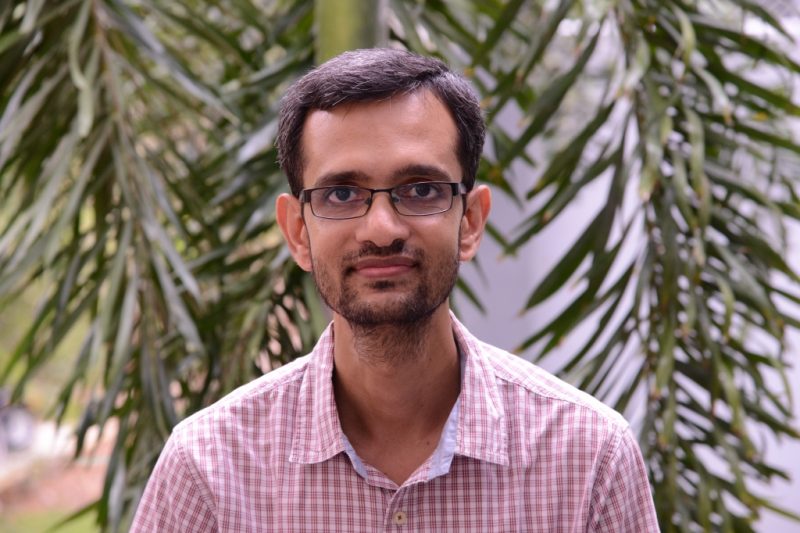
Satyajit Roy began his scientific training in West Bengal, where he earned his master’s degree in chemistry from the University of Kalyani. Driven by a strong interest in transition-metal chemistry, he pursued doctoral research on transition metal–catalyzed carbene and nitrene chemistry under the supervision of Prof. Buddhadeb Chattopadhyay at the Centre of Biomedical Research, Lucknow, and was awarded his Ph.D. degree by Banaras Hindu University.
Following his Ph.D., he moved to the United States for postdoctoral research with
Prof. Rudi Fasan at the University of Rochester, New York, where he developed expertise in biocatalysis within a highly collaborative research environment. In 2023, he continued his postdoctoral work in the same group at the University of Texas at Dallas. In 2026, he joined the Indian Institute of Technology Madras (IIT Madras) as an Assistant Professor. His current research focuses on advancing chemical reactivity and catalysis, with an emphasis on sustainable and transformative strategies in modern chemistry.
Stereodivergent Synthesis of Pyridyl Cyclopropanes via Enzymatic Activation of Pyridotriazoles. Roy, S.; Wang, Y.; Zhao, X.; Dayananda, T.; Chu, J.-M.; Zhang, Y.; Fasan, R. J. Am. Chem. Soc. 2024, 146, 19673–19679.
https://doi.org/10.1021/jacs.4c06103
Stereoselective construction of β-, γ- and δ-lactam rings via enzymatic C–H amidation. Roy, S., Vargas, D.A., Ma, P. et al. Nat Catal. 7, 65–76 (2024).
https://doi.org/10.1038/s41929-023-01068-2.
Biocatalytic Strategy for Construction of sp3-Rich Polycyclic Compounds from Directed Evolution and Computational Modeling. Vargas, D.A., Ren, X., Sengupta, A. et al. Nat. Chem. 16, 817–826 (2024).
https://doi.org/10.1038/s41557-023-01435-3.
Road Map for the Construction of High-Valued N-Heterocycles via Denitrogenative Annulation. Roy, S.; Das, S. K.; Khatua, H.; Das, S.; Chattopadhyay, B. Acc. Chem. Res. 2021, 54, 4395–4409.
https://pubs.acs.org/doi/10.1021/acs.accounts.1c00563
Iron‐Catalyzed Radical Activation Mechanism for Denitrogenative Rearrangement Over C(sp 3 )–H Amination. Roy, S.; Das, S. K.; Khatua, H.; Das, S.; Singh, K. N.; Chattopadhyay, B. Angew. Chem. Int. Ed. 2021, 60,
https://onlinelibrary.wiley.com/doi/full/10.1002/anie.202014950
Iron-Catalyzed Amination of Strong Aliphatic C(sp 3 )–H Bonds. Das, S. K.; Roy, S.; Khatua, H.; Chattopadhyay, B. J. Am. Chem. Soc. 2020, 142, 16211 16217. https://pubs.acs.org/doi/full/10.1021/jacs.0c07810
Iron(II)‐Based Metalloradical Activation: Switch from Traditional Click Chemistry to Denitrogenative Annulation. Roy, S.; Khatua, H.; Das, S. K.; Chattopadhyay, B. Angew. Chem. Int. Ed. 2019, 58, 11439-11443.
https://onlinelibrary.wiley.com/doi/full/10.1002/anie.201904702
Ir-Catalyzed Intramolecular Transannulation/C(sp 2 )–H Amination of 1,2,3,4-
Tetrazoles by Electrocyclization. Das, S. K.; Roy, S.; Khatua, H.; Chattopadhyay, B. J. Am. Chem. Soc. 2018, 140, 8429-8433.
https://pubs.acs.org/doi/full/10.1021/jacs.8b05343
Cobalt(II)-Based Metalloradical Activation of 2-(Diazomethyl)pyridines for Radical Transannulation and Cyclopropanation. Roy, S.; Das, S. K.; Chattopadhyay, B. Angew. Chem. Int. Ed. 2018, 57, 2238-2243.
https://doi.org/10.1002/anie.201711209

MORE FACULTY View All